
glossary
Stepper
Stepper is a camera that prints one field from a glass plate, then steps to the next field, again and again across a disk. A scanner is the cousin that slides the image.
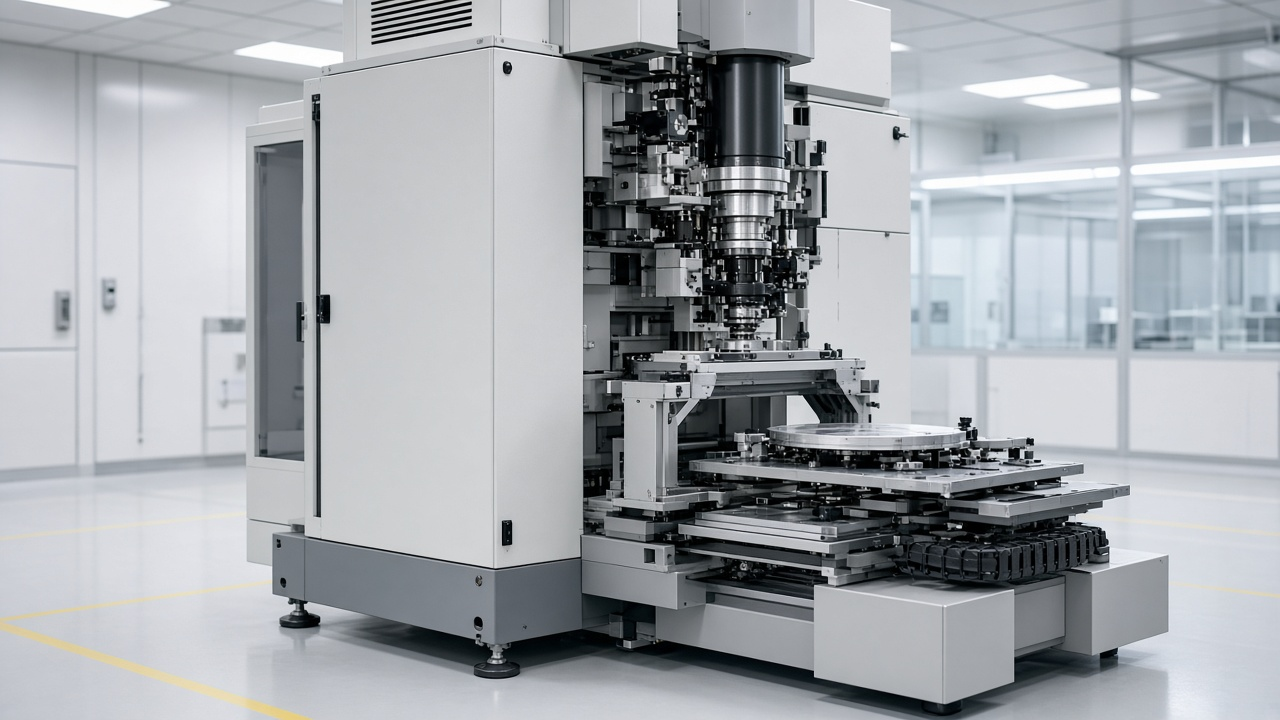
The camera that prints one field, then steps to the next field.
Field size is a hard wall. A 26 millimeter by 33 millimeter field is a typical number. The die plus the scribe must fit, or stitching has a price. The plate is a reticle, often 4× larger than the wafer image. Alignment marks on the drawing are how the stepper finds the last layer. The tool is the size of a room. The wafer map is a set of repeated rectangles. A 300 millimeter wafer might take a hundred steps per layer.
The stepper does not print the whole wafer in one flash. It prints a field, moves, and prints. Edge dies can be partial. Yield maps follow that grid. Without a plate, an e-beam writes directly and does not step a field in the same way. OPC exists because stepper optics are not a perfect shadow.
Overlay is the other number. A via that must sit inside metal has a budget for how far this print may miss the last print. Overlay marks sit in the scribe, and a foundry spec such as 20 nanometers is part of that budget. Enclosure rules already include that miss. Shrinking the enclosure because the drawing looks centered spends the budget twice.
The camera, the plate, and the drawing are covered in steppers and why size matters, what a photomask is, and what is a layout.