
glossary
Reticle
Reticle is the glass plate a stepping camera uses: a few copies of the part, drawn larger than life, printed again and again across a disk.
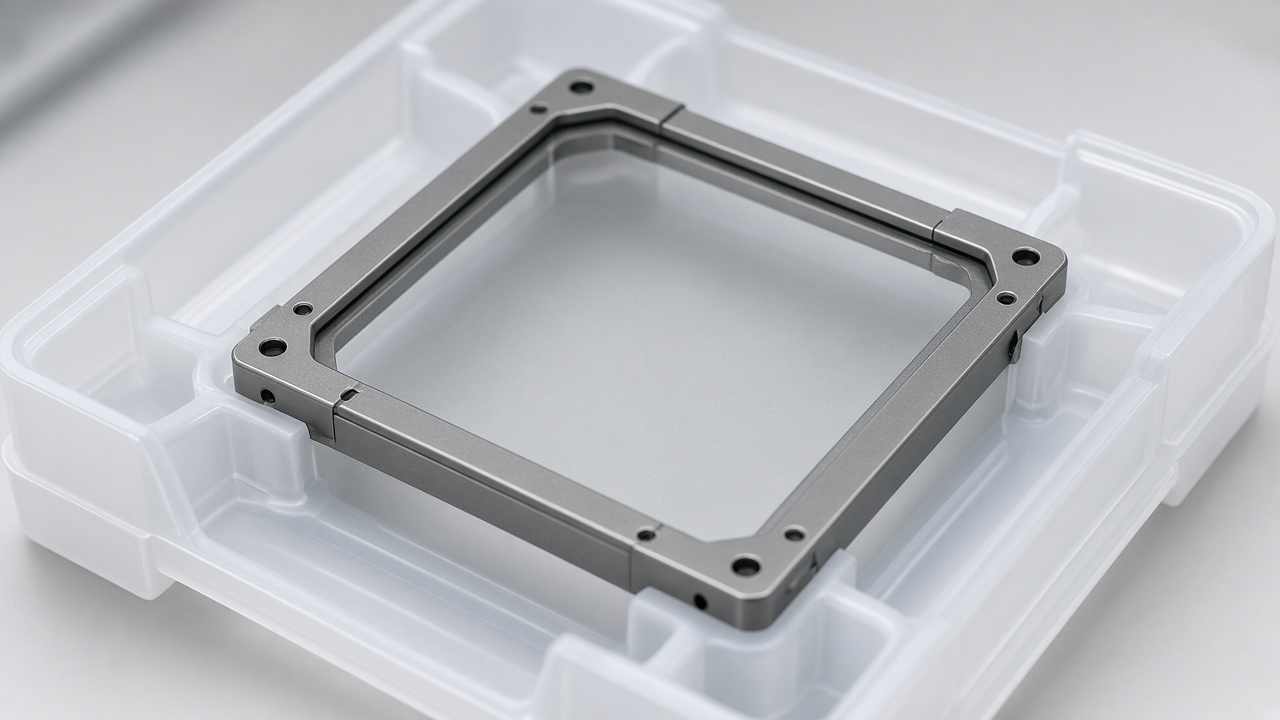
A glass plate in a frame, the plate a stepping camera prints from.
Hallway talk swaps “mask” and “reticle,” and the distinction is money. A photomask in the broad sense is any patterned plate. A reticle is the plate made for a projection stepper or scanner. It often holds one die, or a small array of dies, at 4× or 5× the wafer size. The tool steps the image across the wafer. It does not print the whole wafer in one flash. The stepper prints a field, moves, and prints again. The scribe streets are how those fields later become separate chips.
On the bench the plate is a square of quartz with a patterned rectangle in the middle and alignment marks at the edges. A 5 millimeter chip on the wafer is 20 millimeters on a 4× reticle. A 6-inch plate still shows up even when the printed field is a small die. Pellicles, barcodes, and inspection reports travel with the plate. Reticles are expensive, and a full layer set is many plates. That cost is why people fight over extra layer counts, and why e-beam direct write is tempting for a single prototype. Multi-layer jobs need a set of plates that share alignment. If one layer is written by e-beam on the wafer, that layer has no reticle, and overlay still has to close.
The plate, the camera, and the drawing are covered in what a photomask is, steppers and why size matters, and what is a layout.