
glossary
Matching
Matching is the layout discipline of drawing two or more devices so they age, heat, and print as equals, because the circuit asked them to agree.
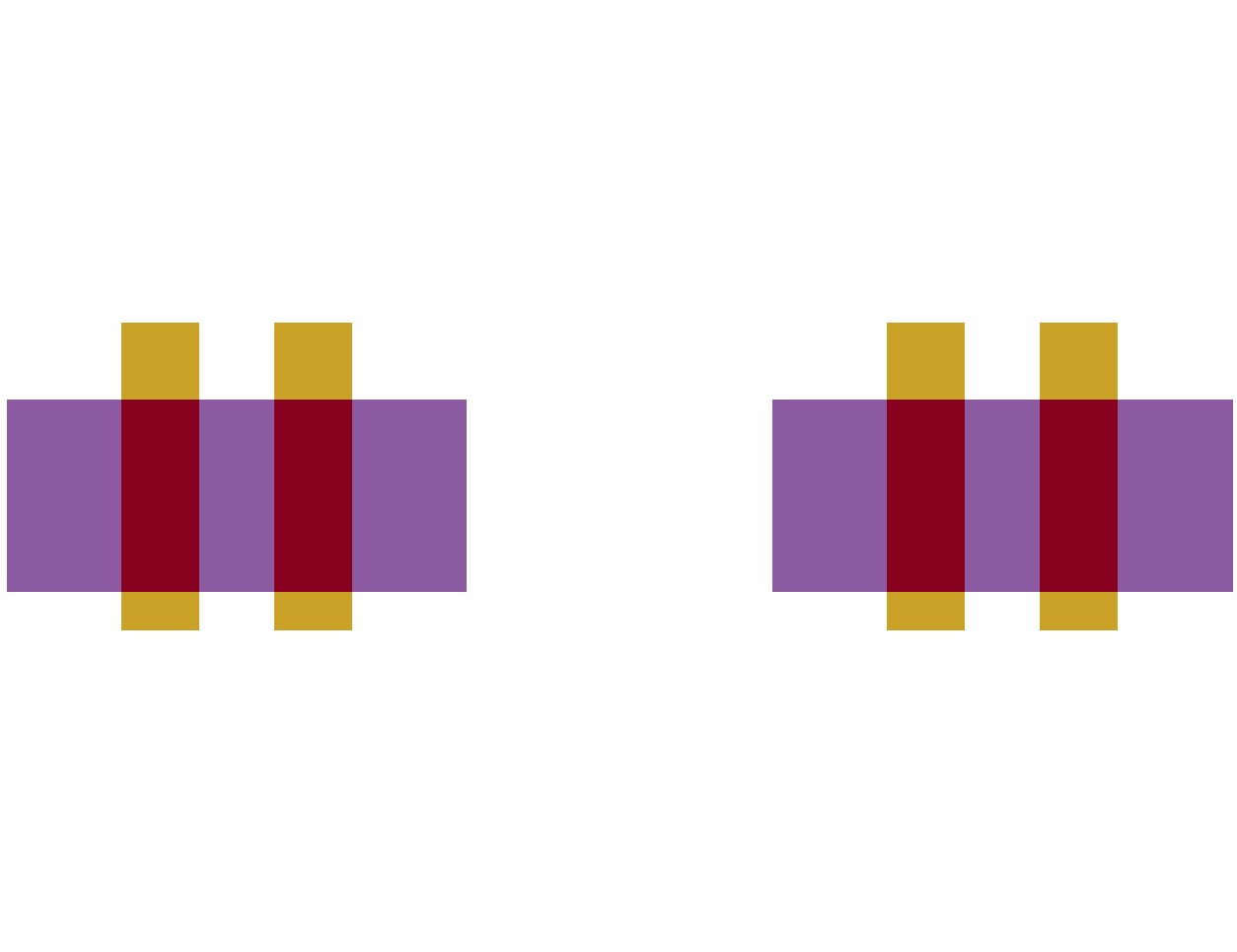
Two devices, same island, same two gates, same spacing, drawn as a pair.
The demand shows up in analog work. A current mirror, a differential pair, or a resistor divider assumes sameness. The schematic states that assumption. The silicon does not supply it unless the drawing does. The devices need the same orientation, the same width and length, the same neighbors, and the same distance from a busy digital net. A 2 micrometer pair that faces opposite ways can disagree after polish. On screen the pair is two transistors drawn as twins, or a row of unit devices interleaved. Dummy devices sit at the ends so the middle ones share an environment.
A famous pattern is common-centroid. Fill and dummy metal can ruin a match if they hug one device and not the other. Hierarchy helps: one unit cell, many instances. A screenshot with equal color area can still put one device on a process gradient and the other in a quiet corner. Matching is about process neighborhoods, not about equal pixel counts.
Two 10 micrometer devices 200 micrometers apart see more gradient than the same devices interdigitated over 40 micrometers. A current-mirror array with dummies at both ends and a shared well tap is the usual drawing. Route the pair with similar metal so one side is not a heater. Matching is layout work that the schematic cannot finish. Placing the pair so the gradient hits both halves the same way, and why that placement is furniture rather than a wire, is covered in analog layout: matching, dummies, and guard rings. The stamp you copy to build the pair is cells and instances.