
glossary
Array
An array is one named drawing repeated at a fixed pitch in rows and columns.
The record stores the master, a start point, a row step, a column step, and two counts. Memory, pads, and fill patterns repeat this way on purpose. The file stays small, and the intent stays visible: this is a bank, not a pile of one-off copies. Change the master cell and the whole farm updates. A 128 by 256 block of tiny bits, or a 2 by 20 pad frame, is the usual case. Click the group and the editor reports 128 x 256 with steps such as 1.2 micrometers and 1.6 micrometers, not 32,768 separate instance names.
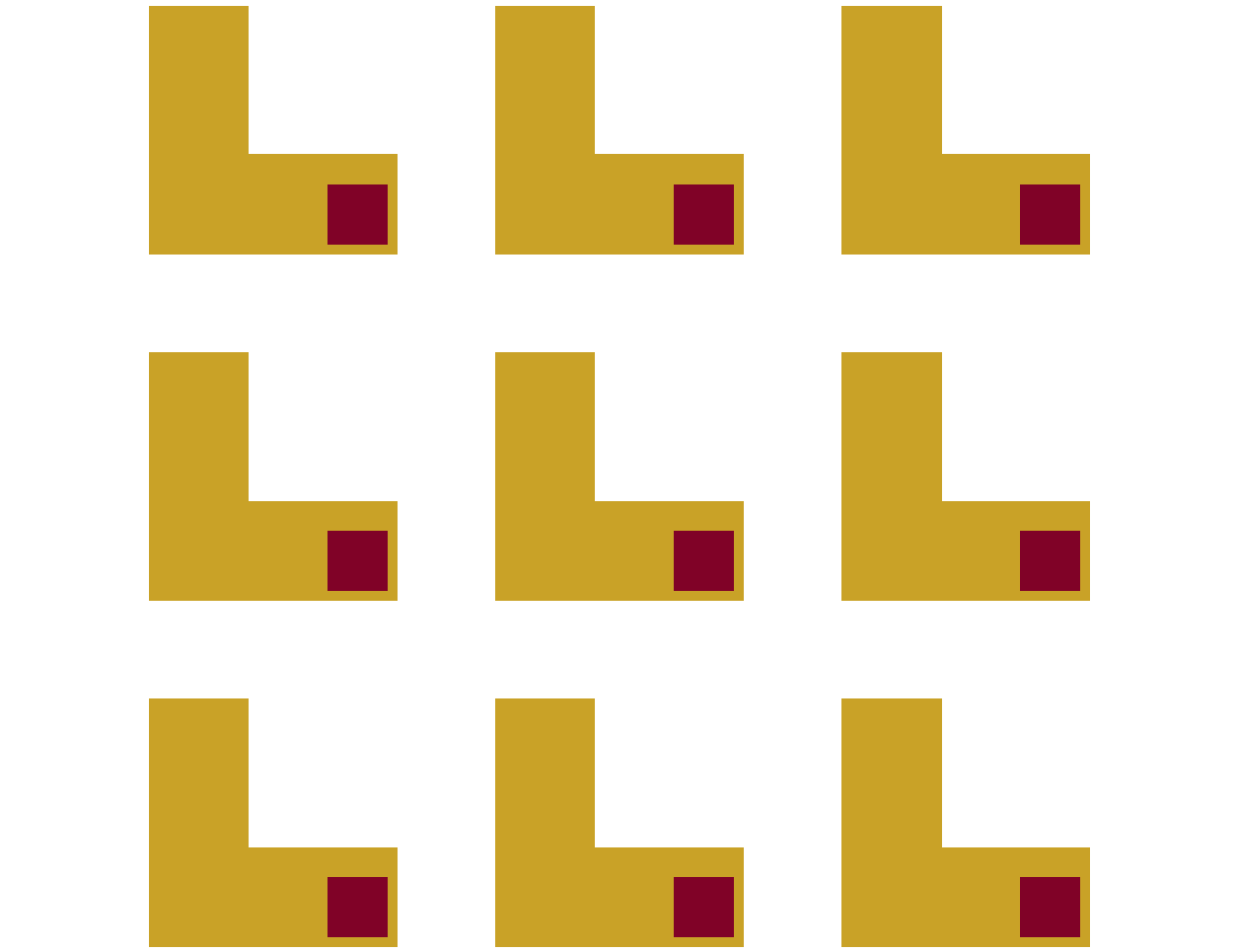
Nine stamps of one L, on a fixed step, in three rows and three columns.
Some tools expand an array into loose instances on save. Others keep the compact record through Graphic Design System II (GDSII). Either way, exploding the farm into raw rectangles is to flatten it. After that, a pitch fix means moving thousands of shapes by hand. An array is a poor fit for things that are almost regular. If row 17 needs a spare, use instances you can delete, or a second array, not a single rigid grid with a hole carved later.
How the repetition is stored, how it relates to cells, and what happens when the farm is exploded are covered in arrays and step-repeat, cells and instances, and flattening.