
glossary
Box
A box is a rectangle stored by two opposite corners, the fastest shape a drawing program can remember.
So much of a chip or a board is axis-aligned: pads, via covers, device islands, keep-away frames. A box uses four numbers and stays honest on a Manhattan grid. Stretch one edge and the opposite edge can stay put. A notch or a diagonal is no longer a box; that shape is a polygon. Drop a contact cover and a 0.22 micrometer by 0.22 micrometer square appears in one click, with handles on the sides rather than a necklace of vertices. A box is not simpler physics. It is a storage habit. Some files keep boxes as boxes. Others explode every rectangle into a four-point polygon on save. Either way the factory sees a rectangle of work on a layer. A fat wire that must bend is usually a path, not a chain of boxes. Most chip tools refuse rotated boxes and ask for a polygon. Board tools are looser, so check what the file format will keep.
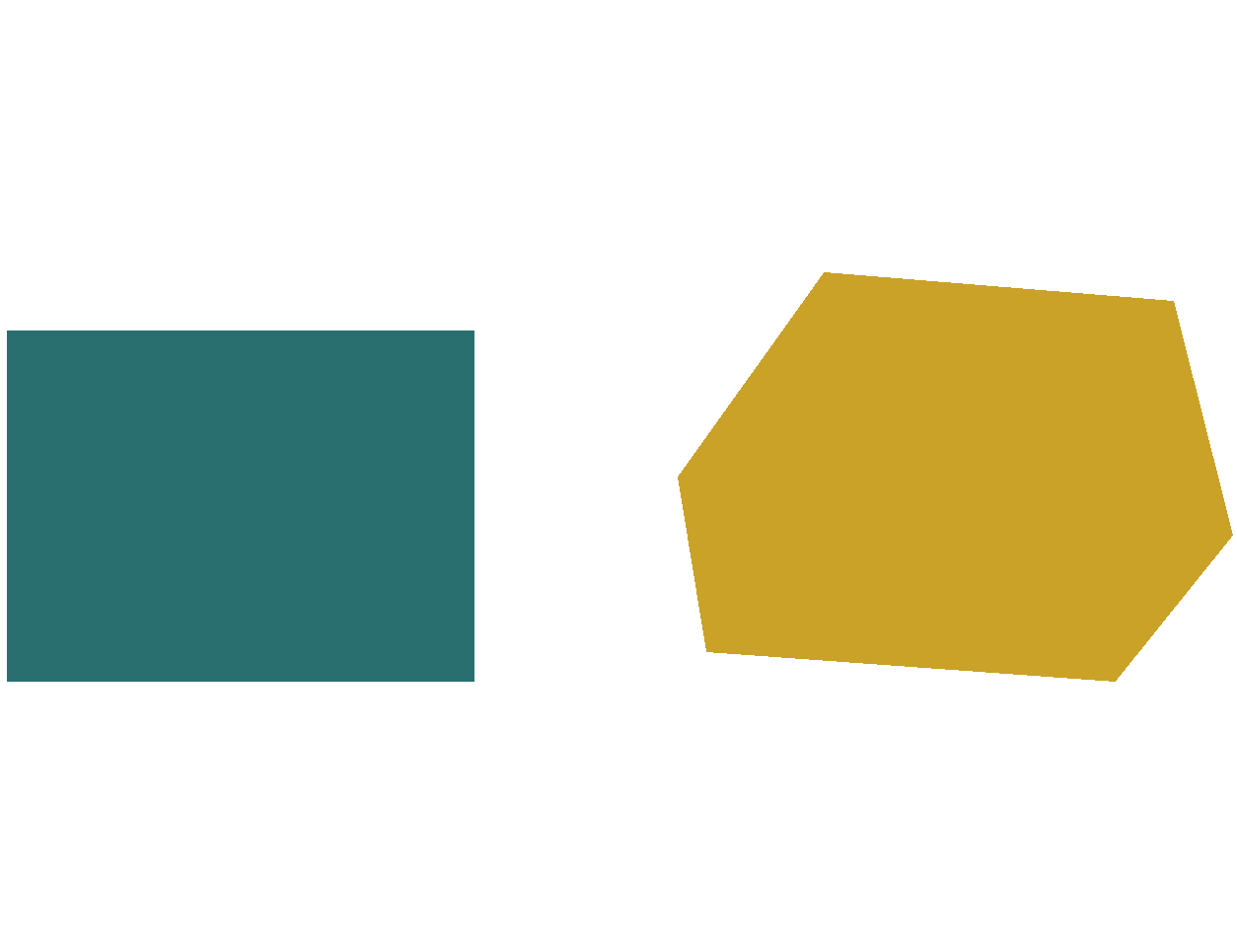
The left shape is a rectangle stored by two corners. The right shape has cut corners, so it is a polygon.
How that rectangle is stored, when a polygon takes over, and where boxes sit in a layout are covered in boxes are rectangles, polygons, the real workhorse, and what is a layout.