
glossary
Database unit
A DBU, a database unit, is the smallest step a layout file can store: an integer tick that later gets a length in real life.
The editor does not store “2.5 micrometers” as a casual decimal. It stores an integer, then multiplies by a scale. If one tick is 0.001 micrometer, a 2.5 micrometer line is 2500 ticks. Miss the scale and every number is a hundred times too big or too small. A file header may say units 0.001 or 1 dbu = 1 nm. Move a vertex by one tick and the status line might show 0.001 µm. Snap settings are usually a multiple of this tick. The visible grid is often coarser than one DBU. Snap pulls points onto that grid. A point that is not on the manufacturing grid is off-grid. Talking in micrometers is a habit. The file still thinks in integers. Changing user units without rewriting the geometry leaves a picture that looks identical while the integers stay put and the scale lies.
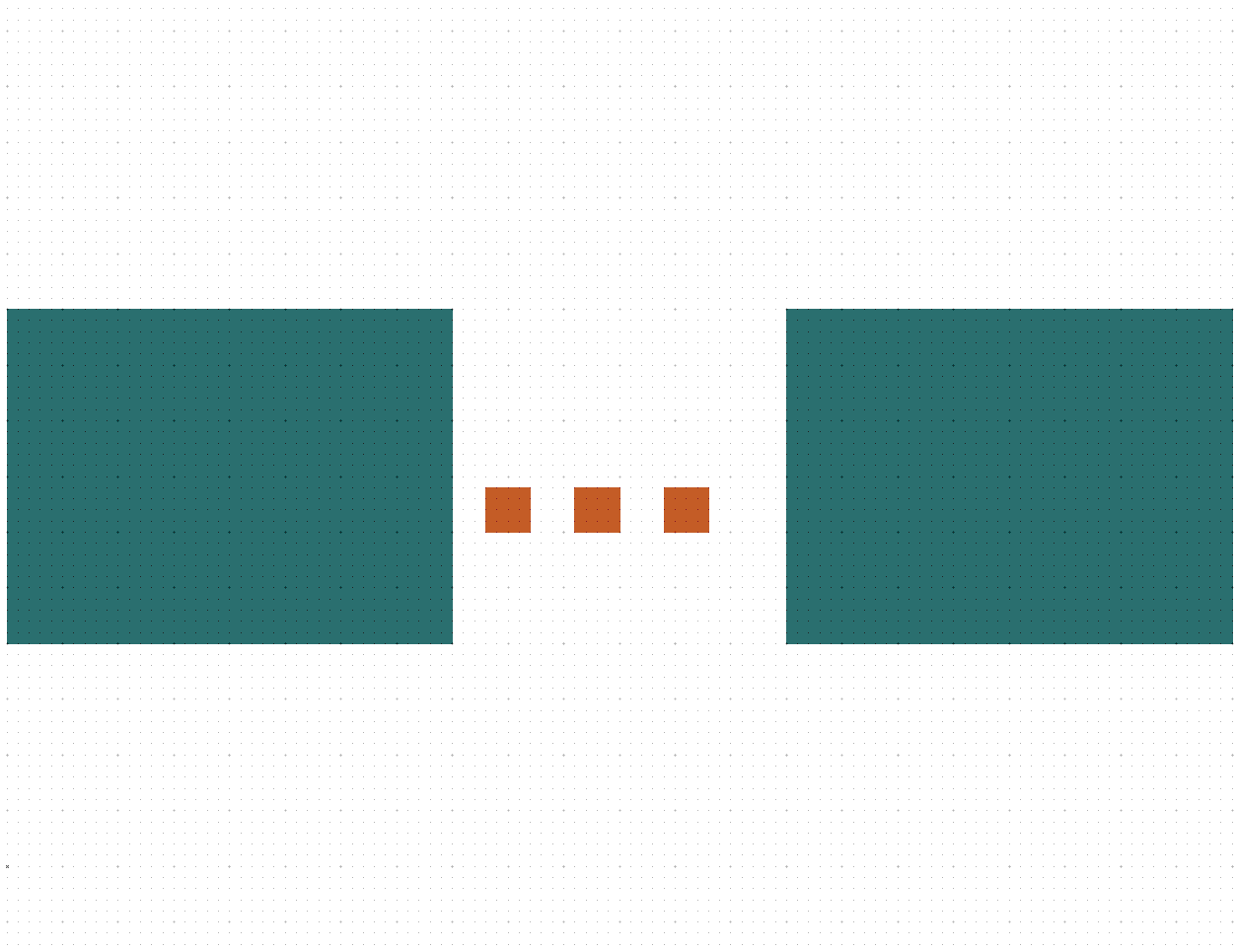
Three ticks sit in the gap between the rectangles. The file stores those ticks, not the micrometers.
How the tick is defined, how the grid uses it, and why the conversation is still in micrometers are covered in database units, the grid, and why layout uses microns.